

Penguin Family Life: Antarctic Animal Facts
Penguin Family Life: Antarctic Animal Facts
Penguins are one of the world's most beloved animals — and for good reason. They're funny, endearing, and surprisingly complex. But beyond their charming waddle and tuxedo-like appearance, penguins lead remarkable family lives filled with teamwork, loyalty, and extraordinary parenting. Let's dive into the world of penguin families.
Meet the Penguins
There are 18 species of penguin, ranging from the tiny Little (Fairy) Penguin found along Australia's coastline to the towering Emperor Penguin of Antarctica. While not all penguins live in Antarctica — some live in South Africa, South America, and even the Galápagos Islands — the Emperor Penguin is the species most associated with extreme cold-weather survival.
How Emperor Penguins Raise Their Chicks
- After mating, the female lays a single egg and immediately transfers it to the male.
- The female then travels up to 80 kilometres to the ocean to feed, while the male stays behind to incubate the egg.
- The male balances the egg on his feet, covered by a warm flap of skin called a brood pouch, for around 65 days — through Antarctic winter, with temperatures as low as −60°C and winds up to 200 km/h.
- During this time, the male doesn't eat at all, surviving on fat reserves and losing up to 45% of his body weight.
- When the chick hatches, the female returns with food, and the parents take turns feeding and protecting the chick.
The Power of the Huddle
During Antarctic blizzards, thousands of Emperor Penguins press together in a tight group to share body heat. The huddle rotates slowly, so every penguin takes a turn on the cold outer edge and the warm inner core. It's a perfect example of community cooperation — no penguin is left out in the cold for too long.
Penguin Communication
In a colony of thousands of identical-looking penguins, how do parents find their chick? Through unique vocalisations. Each penguin has a distinctive call, and parents and chicks learn to recognise each other's voices within days of hatching. Even in a noisy colony of 10,000 birds, a parent can locate its own chick by sound alone.
Fascinating Penguin Facts for Kids
- Penguins are birds that can't fly, but they're exceptional swimmers — Emperor Penguins can dive to depths of 500 metres.
- Their black and white colouring is a form of camouflage called countershading.
- Penguins drink saltwater — they have a special gland above their eyes that filters out the salt.
- Little Penguins, found along Australia's southern coast, are the smallest penguin species, standing just 33 cm tall.
- Penguins can "toboggan" — sliding on their bellies across ice — which is faster and uses less energy than walking.
Are Penguins Threatened?
Many penguin species are under threat from climate change, overfishing, and pollution. As sea ice melts and fish populations decline, penguins face increasing challenges finding food. The African Penguin is critically endangered, with fewer than 50,000 remaining.
Penguin Activities for Kids
- Huddle experiment: On a cold day, have kids stand apart vs. huddle together. Which feels warmer?
- Egg balance challenge: Try balancing a ball on your feet and walking — just like a male Emperor Penguin incubating an egg!
- Sound identification: Listen to recordings of different penguin calls. Can you tell them apart?
- Species research: Assign each child a different penguin species to research and present.
Waddle Into Imaginative Play
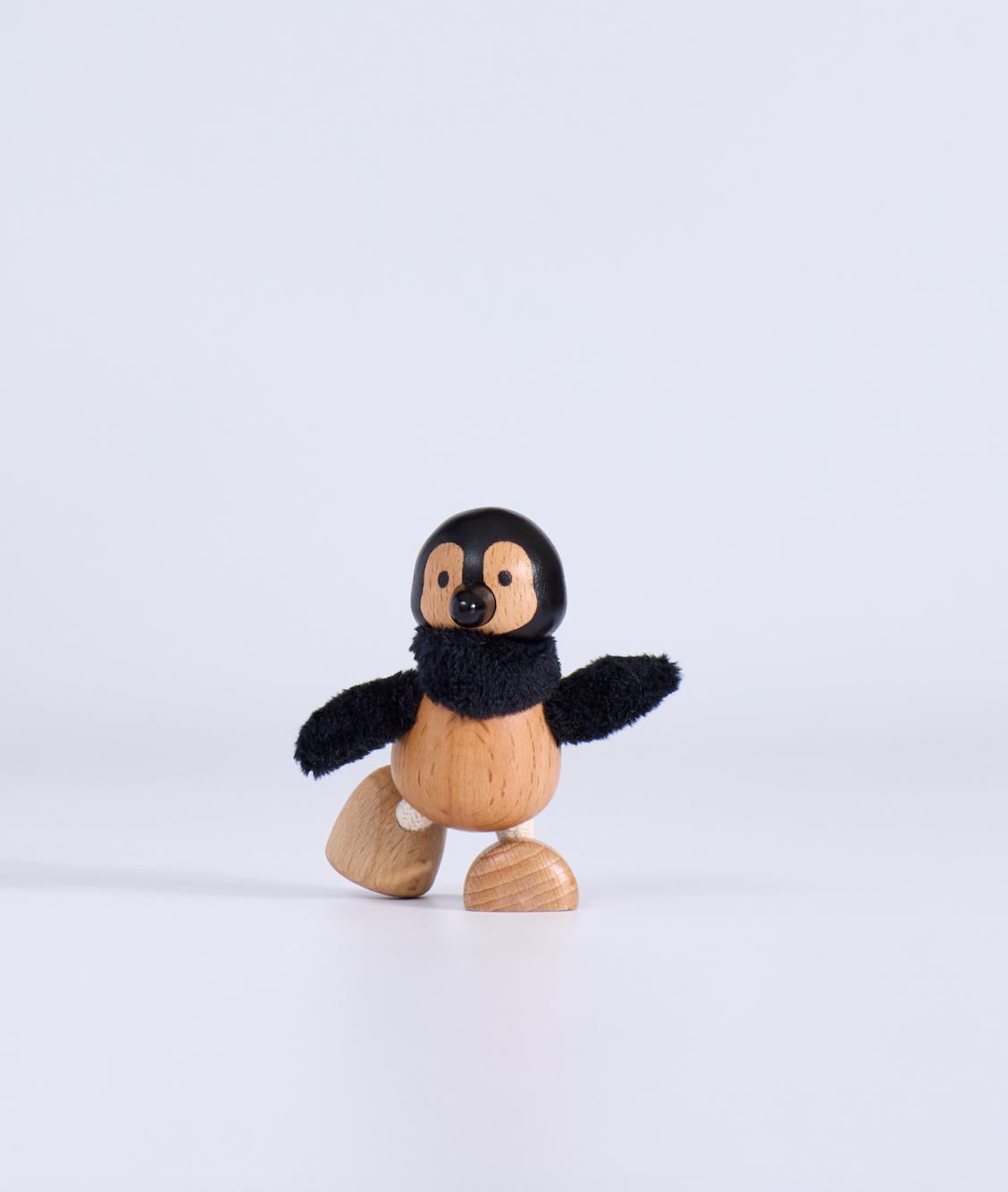
Our Icebergs collection features beautifully crafted wooden penguin figurines and other cold-climate animals, made from sustainably sourced timber.
Shop the Icebergs Collection →
Further Reading & Resources
These trusted organisations and educational sites are wonderful resources for learning more about penguins and their conservation:
- Penguin Research Group — University of Washington — one of the world's leading penguin research programs, with accessible information on penguin biology, behaviour, and conservation across all 18 species.
- IUCN Red List — Penguins — the definitive conservation status assessments for all penguin species, with detailed population data and threat analysis.
- WWF Australia — Little Penguin — WWF Australia's profile of the Little Penguin, covering habitat, threats, and conservation efforts along Australia's southern coastline.
- National Geographic — Emperor Penguin — stunning photography, videos, and facts about Emperor Penguin family life and survival in Antarctica, perfect for classroom research.
- Australian Antarctic Division — Penguins — Australia's official Antarctic research body shares detailed information about the penguin species found in Australian Antarctic Territory, with a strong educational focus.
Explore more animal facts on our Ramblings blog — from moose winter survival to dinosaur discoveries.

Send us a note